The FORTIFIED Roof Standard, Explained Simply
FORTIFIED is a voluntary construction standard from the Insurance Institute for Business and Home Safety, built from real hurricane damage research. Here is what its roof designations require, how the levels differ, and where the standard overlaps with Texas windstorm rules.
A research-based standard, not a brand or a code
The FORTIFIED program was developed by the Insurance Institute for Business and Home Safety, a nonprofit research organization funded by the insurance industry that tests building systems against realistic storm conditions, including at its full-scale wind research facility. Instead of guessing which details matter, researchers examined homes damaged by hurricanes to find the failure points that actually let water and wind destroy interiors, then wrote requirements that address those points.
Two clarifications prevent most confusion. First, FORTIFIED is voluntary and independent: it is not a manufacturer brand, and no single product makes a roof fortified. Second, it is not the same as Texas windstorm code or a WPI-8 certificate, although the goals overlap. Think of code as the legal minimum for insurability in the TWIA area, and this standard as a verified step above that minimum, aimed specifically at keeping the roof on and the water out during a major storm.
FORTIFIED Roof: sealed deck, stronger edges, better fastening
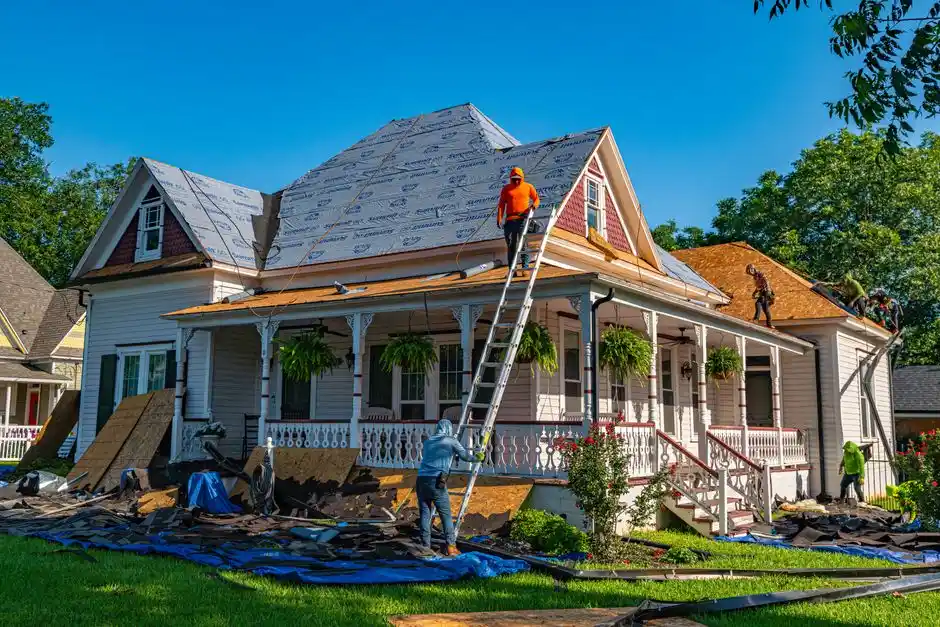
The roof designation, historically associated with the Bronze level, concentrates on the roof system itself. Its signature requirement is a sealed roof deck: seams in the decking are taped or covered with a membrane so that if the outer covering blows off, the deck itself still sheds water instead of pouring it into the attic. That single detail addresses the most common source of catastrophic interior loss in hurricane research.
The other requirements reinforce where roofs typically start failing. Enhanced nail patterns and ring-shank nails grip decking harder than smooth nails. Edges get upgraded drip edge and starter detailing, because uplift begins at perimeters. Attic ventilation openings must be protected against wind-driven rain entry, and the roof covering itself must meet impact and wind requirements appropriate to the location. Each element is documented and verified, as the next section explains, rather than simply promised.
Silver and Gold: from protecting the roof to protecting openings
The broader FORTIFIED Home designations build upward. The level historically called Silver keeps the roof requirements and adds protection for openings and attachments: windows and doors rated or shuttered for impact and pressure, garage doors strengthened against wind pressure, and porches or attached structures tied down properly so they cannot tear away and damage the main roof. Chimneys and other elements get additional bracing attention.
The Gold level then addresses the structure itself, requiring a continuous load path that ties the roof to the walls and the walls to the foundation with engineered connections, so wind forces travel safely into the ground instead of prying the building apart. For most Corpus Christi homeowners replacing a roof, the practical target is the roof-level designation, sometimes paired with opening protection, because those pieces can be added during a re-roof without rebuilding the house's frame.
- Sealed deck keeps water out even if the covering is lost
- Ring-shank nails and denser patterns resist uplift
- Protected vents block wind-driven rain from the attic
Verification and documentation are part of the standard
A defining feature of the program is third-party verification. Trained evaluators document the work, photographs are taken at stages that will later be hidden, and the completed project is reviewed before a designation certificate is issued. Homeowners receive documentation identifying the designation and its details, which can be shared with insurers and future buyers.
That paper trail is the honest difference between fortified as a marketing word and the actual designation. If a contractor uses the term, ask who will perform the evaluation, what documentation you will receive, and whether the certificate will be issued for your address. Keep the answer in the contract. The designation may also need renewal or re-documentation after later roof work, so treat the paperwork like your WPI-8 file: keep it with the house records permanently.
How the standard fits Corpus Christi and TWIA country
Coastal Bend homes sit in design wind zones around 130 to 155 mph, endure a June through November hurricane season, and face salt air that punishes exposed components, so the standard's emphasis on sealed decks, edge strength, and protected openings maps directly onto local failure history. Work planned to this level can be coordinated with Texas windstorm requirements so the same project produces both the designation documentation and the WPI-8 certification needed for windstorm insurability.
Costs rise compared with a basic re-roof because of added materials, fastening, and evaluation fees, though many of the core practices, like sealing the deck, are modest additions when the old covering is already off. The natural moment to consider it is during a planned replacement, since deck access makes the upgrades straightforward. Our standing seam and full replacement ranges on this site, roughly $9,000 to $25,000 for a roof replacement depending on material and scope, give a starting frame before fortified additions are priced in.
Who benefits most from building to this level
Homes closest to open water, homes whose owners plan to stay for decades, and homes where a previous storm claim exposed weak deck or edge details gain the most. The sealed deck alone changes the worst-case outcome: losing shingles in a hurricane becomes a repair bill instead of a gutted interior. For inland homes with newer roofs, waiting until replacement time and building to the standard then is a reasonable, economical sequence.
Sparkling City Roofing is a referral service. We can connect you with local contractors for a free inspection and a written, itemized quote, and you can ask any contractor directly about their experience installing and documenting work to this standard, who verifies it, and what paperwork you will hold at the end. Those answers, in writing, are worth more than any badge in an advertisement.
Common questions
Good questions
Does a FORTIFIED designation guarantee a lower insurance premium?
Sometimes, depending on the carrier and the documented designation, but the amount and eligibility vary and change. Treat any discount as a bonus rather than the reason for the upgrade, and ask your insurer in writing which FORTIFIED documentation they accept and what credit applies before you commit to the extra work.
Can my existing roof be upgraded to FORTIFIED without replacing it?
Generally no, not in full. The standard's strength comes from the sealed deck, enhanced fastening, and edge details being installed and documented as one system. A conventional roof can adopt individual good practices, such as a sealed deck membrane, but the designation itself is verified on work installed to the program's requirements.
What damage patterns did IBHS research find most often after hurricanes?
Findings vary, but edge failures and older, weakened roof coverings show up repeatedly, along with decks that were not sealed, so a cover failure let water straight into the attic. Those patterns are instructive for any coastal homeowner: the opening created at an edge or by a missing cover is usually where the serious interior damage begins.
If my roof is FORTIFIED, do I still need WPI-8 paperwork for TWIA?
Yes. TWIA insurability follows Texas windstorm code and the WPI-8 certification process. FORTIFIED addresses many of the same risks with its own independent verification, and work can be planned to satisfy both sets of documentation, but neither certificate substitutes for the other. Confirm both requirements with your contractor before work begins.